
Using PRISMA 2020 in a Nursing Systematic Review
A practical guide to transparent reporting, study selection and the PRISMA flow diagram.
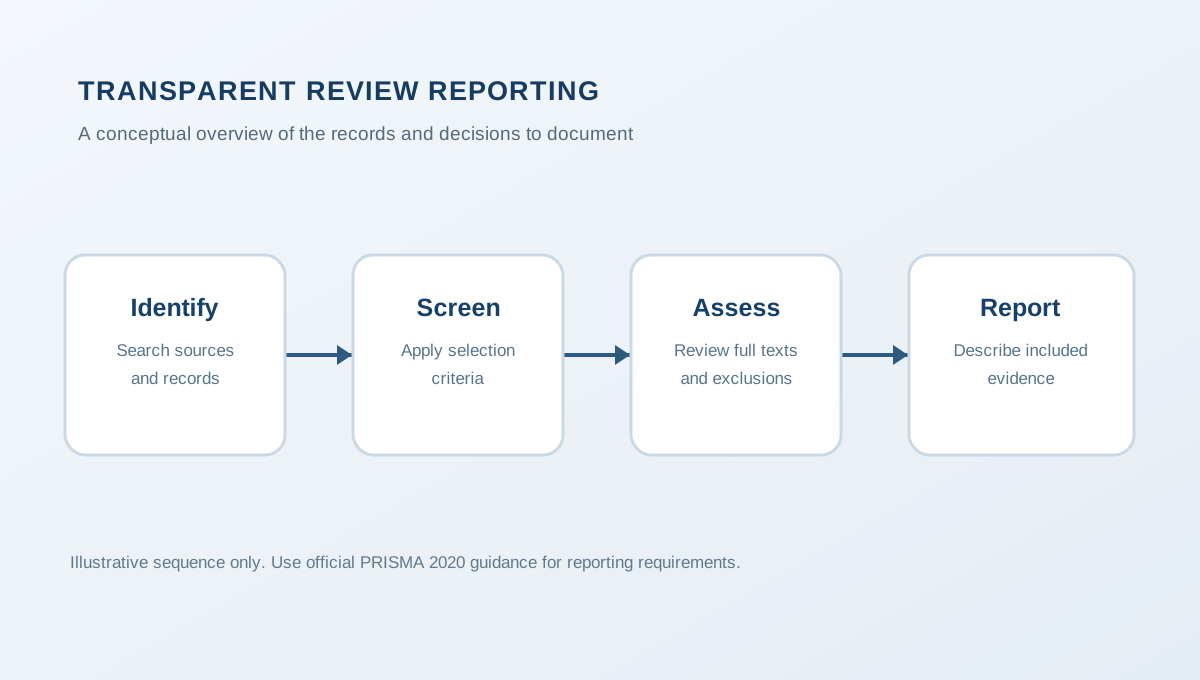
PRISMA 2020 provides a reporting framework for systematic reviews. It helps authors explain what they set out to do, how evidence was located and selected and what was found. For nursing researchers, this transparency is especially important when a review may inform decisions about patient care, staffing or education. PRISMA is not a substitute for a sound review method and completing a checklist does not make an inadequate search rigorous. Its value lies in helping readers understand and assess the work that was actually undertaken.
Understand what PRISMA does and does not do
PRISMA stands for Preferred Reporting Items for Systematic Reviews and Meta Analyses. The 2020 statement updates guidance on how systematic reviews should be reported, reflecting changes in evidence synthesis and information retrieval. Its checklist addresses the title, abstract, rationale, methods, results, discussion and other information that readers need to interpret the review. The accompanying flow diagram explains how records moved through identification and screening.
The distinction between reporting and conduct matters. A student can complete a flow diagram after an inadequate search, but the diagram does not correct missing databases or inconsistent eligibility decisions. Good practice requires a suitable protocol, careful searching, reproducible selection and appropriate appraisal. PRISMA helps report those steps clearly; it should be used alongside methodological guidance from relevant evidence synthesis organisations.
An early discussion with a supervisor should establish whether the assignment is a formal systematic review or a structured literature review. The reporting expectations and resources may differ considerably. Calling a project systematic does not make it so, especially when the search and selection procedures cannot be reproduced. Describe the work accurately and use the reporting guidance appropriate to its actual design.
Frame a question that determines eligibility
Before searching, specify the review question and the criteria for including studies. An effectiveness review of nurse led medication reconciliation might define the patient population, intervention, comparison, outcomes and eligible study designs. A review of patient experiences may need a different framework and may not be suited to the same synthesis methods. The reporting checklist cannot resolve a question that remains too broad.
Eligibility criteria should be justified rather than invented after seeing the results. Restrictions by language, publication date or setting can shape the evidence base and may introduce bias. If a student includes only adult inpatient studies, the review should explain why that boundary matches the clinical purpose. A clearly documented question reduces the risk of selecting studies because their findings appear convenient.
For a review of nurse led follow up after discharge, the outcome may be appointment attendance, medication understanding or unplanned readmission. These outcomes should not be treated as interchangeable. A study can report improved understanding without showing a change in readmissions. The eligibility criteria should state which outcomes matter and the synthesis should preserve those distinctions.
Develop a protocol before the results are known
A protocol describes the planned review methods before the evidence has been fully examined. It should cover the question, eligibility criteria, information sources, screening approach, appraisal strategy and intended synthesis. For appropriate reviews, registration or public availability can strengthen transparency, although the available registration routes and institutional requirements differ.
Changes may be necessary when the literature proves different from what was expected. The important principle is to document what changed and why rather than silently rewriting the plan to match preferred findings. A protocol also helps students divide tasks and identify practical constraints early. It is easier to defend a thoughtful amendment than an unexplained methodological inconsistency.
Protocol planning is also an opportunity to decide how disagreements will be handled. If two reviewers are available, specify how independent screening and resolution will work. If the project is conducted by one student, describe that limitation honestly and discuss any available checking arrangements. Transparency about the review team is preferable to implying procedures that did not occur.
Make the search strategy reproducible
Systematic searching requires more than listing database names. Report when each source was searched, the search strategy used and any limits applied. Nursing reviews commonly draw on biomedical and nursing databases, with the selection guided by the topic and study designs of interest. Controlled vocabulary and free text synonyms often need to be combined because different databases index similar concepts differently.
Save complete search strings rather than relying on memory or screenshots of result totals. A reviewer should be able to understand how the records were retrieved. Supplementary methods such as reference checking may be appropriate and should be reported separately. A search that is transparent but too narrow remains a limitation, so consider whether important concepts or populations have been missed.
A database may change its indexing over time, so record the exact date of each search. Search syntax should be copied from the platform actually used rather than translated informally from another database. If a filter removes studies based on language or publication type, report it. Those decisions can affect which evidence becomes visible in the final review.
Keep accurate identification and screening records
The PRISMA flow diagram tracks records identified from databases, registers and other sources through removal of duplicates, screening and inclusion. Students should distinguish records from reports and studies because a single study can have more than one report. Misunderstanding those categories can lead to inconsistent totals and misleading diagrams.
Decide in advance how records will be managed and how decisions will be recorded. At title and abstract screening, reviewers apply the eligibility criteria to available information. Full text screening requires a more detailed assessment and reasons for exclusion should be documented at the appropriate stage. If multiple reviewers are involved, the process for resolving disagreements should be described.
Keep a record of why full text reports were excluded. Reasons should reflect the predetermined criteria and be specific enough to understand. For example, an article may concern an eligible population but evaluate an intervention outside the review scope. A clear exclusion log makes the flow diagram easier to reconcile and helps prevent inconsistent decisions across similar papers.
Explain the difference between records, reports and studies
A database result is a record, while the retrieved full text or other document is a report. The underlying investigation is the study. These are related but not always identical units. A trial may generate a protocol paper, a primary outcomes paper and a later follow up report. Counting all three as independent studies could exaggerate the evidence base.
The flow diagram should be assembled from a consistent record management log. When students discover duplicate reports late in the process, they should correct the counts and explain how reports were linked to studies. Precision in these apparently administrative details is part of research integrity because readers rely on the diagram to understand the scope of the evidence.
Before drawing the final flow diagram, reconcile the reference management counts with the screening log. Check the number of duplicates removed, records screened, reports sought and studies included. Apparent discrepancies often arise when multiple reports describe one study or when a full text cannot be retrieved. The final numbers should follow the official template definitions rather than being adjusted to look tidy.
Appraise studies without reducing quality to a score
Risk of bias assessment concerns the credibility of findings, not merely whether an article looks professionally written. The appropriate tool depends on study design and review purpose. Randomised trials, non randomised intervention studies and qualitative studies raise different appraisal questions. The review should explain which approach was used and how judgements were reached.
Avoid assigning an overall quality label without showing what it means. A study may be strong in outcome measurement but weak in allocation or follow up. Those weaknesses may matter differently depending on the review question. Appraisal should inform the interpretation of findings rather than appearing as an isolated table that is never discussed again.
Appraisal judgements should be linked to the outcomes that matter. In an intervention study, incomplete outcome data may be especially consequential when patients with poor outcomes are more likely to be lost to follow up. Another domain may be less influential for a particular result. Discuss the implications rather than relying solely on an overall label that conceals the reasoning.
Report synthesis decisions and uncertainty
A meta analysis is not required for every systematic review. Pooling results may be inappropriate when studies differ substantially in participants, interventions, outcomes or design. A narrative synthesis can be rigorous when the grouping of studies, comparisons and reasoning are explicit. Students should not present the absence of statistical pooling as a failure if pooling would obscure important differences.
When quantitative pooling is justified, report the effect measures, model and approach to heterogeneity in a way that readers can evaluate. Whether or not a meta analysis is conducted, discuss how limitations of the included studies affect confidence in the findings. A conclusion about nursing practice should not be stronger than the evidence permits.
When studies use different scales, compare the underlying constructs before attempting to combine results. Two questionnaires may both be described as measuring satisfaction while capturing different aspects of care. Even when numerical pooling is possible, clinical heterogeneity can limit interpretability. Explain why the synthesis method chosen offers the clearest answer to the review question.
Use the checklist while drafting each section
The PRISMA checklist is most useful as a working editorial tool rather than a last minute administrative attachment. Check the abstract for essential methods and results, ensure the methods describe selection and appraisal and make sure the results connect back to the stated outcomes. Tables should help readers locate study characteristics and findings without replacing necessary explanation in the text.
A checklist item may not apply to a particular review, but that should be considered rather than ignored. Some journals and institutions require specific submission formats. Follow their instructions while keeping the underlying reporting principles intact. The official PRISMA website provides downloadable checklists and flow diagram templates that should be consulted directly.
As a final reporting check, compare the methods described in the manuscript with the results actually presented. Every planned outcome should have an explanation, including when no eligible data were available. Any additional analyses should be labelled clearly. Readers should not have to infer whether a result was planned or introduced after the data were examined.
Interpret the completed review responsibly
The discussion should explain what the findings mean for the original nursing question, how they compare with existing knowledge and where uncertainty remains. Avoid treating statistical significance as equivalent to clinical importance. An intervention may produce a measurable change that is too small to justify implementation, while a clinically meaningful pattern may remain uncertain because of imprecise evidence.
Describe limitations at both the study level and the review level. Search restrictions, missing data and inconsistent definitions may influence the conclusions. A well reported review does not promise certainty where there is none. Its contribution is to show what the available evidence supports and what further investigation would be most useful.
The conclusion should separate implications for practice from implications for research. Weak or inconsistent evidence may support a recommendation for better trials rather than immediate clinical adoption. Conversely, a consistent pattern may still need evaluation for feasibility in a particular setting. A transparent review equips clinicians to make judgements rather than presenting the literature as a simple vote for or against an intervention.
A nursing research example
A useful worked example is a review of nurse led telephone follow up after discharge. Imagine that the initial database searches return several hundred records, including conference abstracts and multiple papers from the same trial. After duplicates are removed, the reviewers screen titles and abstracts against the protocol. Some records are clearly about unrelated populations, while others need full text inspection because the abstract does not describe the intervention in enough detail. At the full text stage, an article might be excluded because follow up was delivered by a multidisciplinary team without a separately identifiable nursing component. Another might be eligible but report only patient satisfaction rather than the review's prespecified primary outcome. The eligibility decision and the synthesis decision are not the same, so the reviewers should avoid excluding an otherwise eligible study solely because it lacks one preferred outcome. The flow diagram records the movement of records and reports, while the study characteristics table explains the evidence that remains. In the discussion, the authors should distinguish evidence of improved attendance from evidence about clinical outcomes and note whether the interventions were delivered consistently. This example illustrates why PRISMA reporting works best when the review team has maintained an accurate decision log throughout the project rather than attempting to reconstruct the process after the writing is finished. The official PRISMA 2020 explanation and elaboration document provides detailed examples of what individual checklist items require. Consulting that document while drafting can help prevent apparently small omissions that make a review difficult to reproduce.
Putting the guidance into practice
Before completing the next draft of your nursing research project, return to the central question and write down the decisions that follow from it. Explain why your chosen methods, reporting approach or appraisal criteria will produce a useful answer and where uncertainty remains. Discuss the plan with your supervisor before collecting data or making changes that may require institutional permission. Careful research is not defined by a perfect result, but by a transparent process that another reader can examine and question.
Use research tools to record decisions about PRISMA study selection and reporting decisions; check the resulting work against original methodological standards and your institution’s rules.
Methodological references and further reading
The linked standards can help you verify PRISMA study selection and reporting decisions. Select resources that match your actual research question and chosen method.
Need guidance on your nursing research?
Have questions about a PRISMA flow diagram or reporting a search? We can help you make sense of the requirements and work through your specific review.
Editorial note. All clinical scenarios are illustrative rather than accounts of actual patients or research participants. Follow your institution's research governance and academic integrity requirements.