
Critical Appraisal of Nursing Research Evidence
How to evaluate study credibility, relevance and limitations before drawing conclusions for practice.
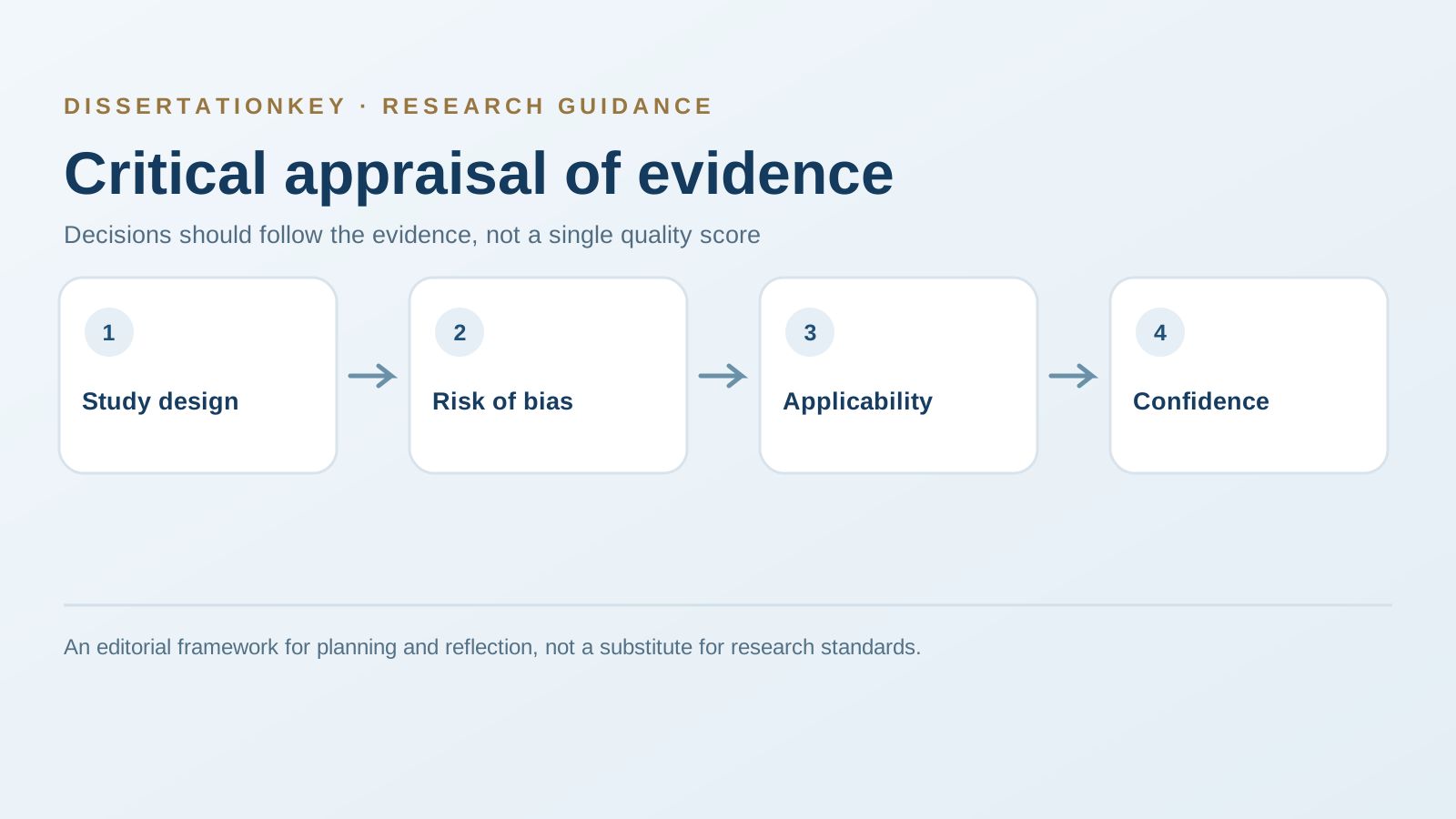
Critical appraisal is the process of asking whether research findings deserve the confidence a reader might place in them. Nursing students need this skill when preparing literature reviews, evaluating interventions or deciding whether published evidence applies to a clinical problem. An article can be peer reviewed and still contain important limitations. Equally, a modest study may offer useful insight when its purpose and methods are well matched. The aim is not to dismiss research but to understand precisely what it can and cannot tell us.
Start with the question the study actually answered
Read the aim and methods before focusing on the conclusion. A study reporting that nurses with more training also have greater confidence does not necessarily establish that training produced the confidence. Another factor, such as years of experience or access to support, may influence both. The appraisal begins by identifying the population, setting, exposure or intervention and outcomes.
Compare the study question with the question you need to answer. A paper about adults in intensive care may not apply directly to community dwelling older adults. Relevance is not an all or nothing judgement, but the reasons for transferability should be explicit. A carefully designed study can be methodologically strong while offering only indirect evidence for a particular nursing decision.
Begin by writing a one sentence summary of the study claim without using the authors’ preferred language. Then check whether the methods genuinely support that sentence. This habit reduces the influence of persuasive abstracts and discussion sections. It also makes it easier to compare papers that use different terminology for similar questions.
Identify the design before choosing an appraisal tool
Different research designs have different strengths and vulnerabilities. Randomised trials can support stronger causal claims when allocation and follow up are well managed. Observational studies can describe associations and real world patterns but may be affected by confounding. Qualitative studies can explore experiences and processes that numerical outcomes alone do not explain.
Choose an appraisal framework appropriate to the design and the review purpose. JBI and CASP provide structured resources for several forms of evidence, while risk of bias tools used in systematic reviews address specific methodological concerns. A single generic checklist applied to every paper can hide important differences. The tool should support reasoning rather than replace it.
In an evidence table, include the design as well as the source of the data. A retrospective record review and a prospective survey may both be observational, yet they face different measurement and missing data problems. Design labels are useful only when accompanied by enough detail to evaluate how the evidence was produced. Avoid assuming that a familiar label guarantees a particular level of rigour.
Examine recruitment and selection carefully
Ask who was eligible, how participants were identified and who ultimately took part. A survey of nurses who voluntarily attend a professional development event may overrepresent people interested in the subject. A hospital study may exclude patients who cannot complete questionnaires in the dominant language. These decisions affect which experiences or outcomes the results reflect.
Selection bias can occur when participation is related to both the factor being studied and the outcome. The paper should report enough information about recruitment and non participation to allow a reasoned judgement. Do not assume that a large sample eliminates selection bias. A large but systematically unrepresentative sample can produce precise estimates of the wrong population.
When a paper reports a high response rate, examine who was invited in the first place. A strong response from a narrowly selected group does not resolve the question of whether the group represents the target population. Equally, a lower response rate does not prove bias without considering the characteristics of respondents and nonrespondents. The appraisal should remain evidence based rather than mechanical.
Assess measurement and data quality
The credibility of quantitative findings depends on what was measured and how. A project claiming improved medication adherence should specify whether adherence came from self report, dispensing data or another source. Self report can be affected by recall and social desirability, while dispensing records cannot establish that medicine was taken as prescribed.
Look for evidence that measures are suitable for the population and setting. Translation, changes in administration and unclear definitions can affect validity. In qualitative research, consider whether interview questions, observation procedures and recording methods were capable of capturing the phenomenon. Data quality is not an abstract property of a study; it depends on the relationship between the question and the evidence collected.
Ask whether the measurement instrument captures the clinical concept in a way that matters to the question. Confidence in using a procedure is not the same as demonstrated competence, and patient satisfaction is not necessarily evidence of clinical effectiveness. A study may accurately measure one construct while drawing conclusions about another. That mismatch is an important appraisal finding.
Consider confounding and causal interpretation
An observed association may have several explanations. Patients receiving more intensive nursing follow up may differ from other patients in illness severity, motivation or access to services. If those differences also affect the outcome, a simple comparison may misrepresent the intervention contribution. Appraisal should examine whether the design and analysis addressed plausible alternative explanations.
Statistical adjustment can reduce some confounding but does not automatically remove it. Important factors may not have been measured and models depend on assumptions. Students should be cautious when authors use causal language for observational findings. The safest summary states what was observed and then explains the limits of causal interpretation.
Confounding can sometimes be explored by drawing a simple explanation of how the variables might be related. For example, staff experience may influence both participation in training and patient communication outcomes. Such reasoning helps identify what the authors would need to measure. It also prevents the appraisal from treating statistical adjustment as a substitute for understanding the clinical process.
Look closely at missing data and follow up
Participants who withdraw or cannot be contacted may differ from those who remain. In a discharge intervention study, people with greater care needs may be harder to follow up and may also have different outcomes. Missing data can therefore distort results, particularly when the extent and reasons are poorly reported.
Ask whether the study explains attrition and how missing observations were handled. A low overall loss to follow up is reassuring but not conclusive if losses are concentrated in one group. In longitudinal qualitative work, changes in participation may also shape the range of experiences represented. The appraisal should connect these issues to the claims made in the findings.
Look for differences between groups at baseline and changes in those groups over time. If an intervention ward had a lower initial risk than a comparison ward, the observed outcome may reflect more than the intervention. The study may have methods to address that problem, but the reader should inspect them rather than assume comparability. Clear baseline information helps interpret the results.
Evaluate qualitative credibility on its own terms
Qualitative appraisal is not a search for the same controls expected in an intervention trial. Consider whether the research approach suits the question, whether participants were selected appropriately and whether the analysis is grounded in the material collected. Reflexivity matters because researchers bring professional experience and assumptions to interviews and interpretation.
Look for clear examples showing how themes or interpretations were developed. A few vivid quotations cannot by themselves demonstrate that the analysis was systematic. Consider whether alternative interpretations were explored and whether the account acknowledges contradictory experiences. The goal is a credible explanation of meaning and context rather than statistical generalisation.
A qualitative paper should give readers enough context to judge whether the interpretation is plausible. This includes information about recruitment, researcher position, data collection and the movement from accounts to themes. A lack of numerical generalisability is not itself a flaw in a study designed to understand experience. Appraisal should evaluate the claims the researchers actually make.
Distinguish statistical results from clinical importance
A statistically detectable difference may have little practical effect on patient care. Conversely, a study may be too small to estimate a potentially meaningful effect precisely. Confidence intervals can help readers understand the range of values compatible with the data, although they do not eliminate bias or measurement problems.
For nursing interventions, ask what the outcome means to patients and staff. A modest reduction in documentation time may be valuable in a high volume setting, but its importance depends on implementation cost and whether safety is maintained. Appraisal should connect numerical results to clinical context without allowing personal enthusiasm to substitute for evidence.
Consider whether the outcome is patient centred or mainly convenient to measure. A reduction in time spent completing documentation may benefit staff, but it should not automatically be presented as improved patient safety. Clinical relevance depends on the link between the measure and the outcomes that matter. The strongest discussion keeps that link explicit.
Synthesize appraisals across a body of evidence
A literature review should not stop at giving each paper a quality label. Compare where studies agree, where they differ and which methodological limitations might explain the pattern. Several studies using similar weak measures do not necessarily provide strong evidence merely because their conclusions are consistent.
A synthesis table can record design, population, major findings and appraisal concerns. Use it to support narrative reasoning rather than to rank papers mechanically. When evidence conflicts, investigate whether participants, interventions or outcomes were sufficiently comparable. The most useful conclusion often identifies the conditions under which a finding appears credible.
When comparing studies, note whether apparently conflicting findings may result from different definitions or follow up periods. A short term improvement in knowledge can coexist with no observed change in long term behaviour. Neither study must be wrong. The synthesis should explain the difference before deciding how much confidence to place in the broader claim.
Write a balanced appraisal in academic prose
A good appraisal names a specific methodological issue and explains its consequence. Rather than saying a study is unreliable because the sample is small, explain whether the sample limits precision, diversity of experience or the ability to examine relevant subgroups. Avoid generic criticism that could be applied to any paper regardless of design.
End by describing how the evidence contributes to the nursing question despite its limitations. A study may be useful for understanding implementation barriers even when it cannot demonstrate effectiveness. Balanced appraisal helps a dissertation build a defensible argument and prepares the reader for realistic recommendations rather than exaggerated claims.
A balanced critique often uses a three part structure. Describe the design feature, explain the risk it introduces and state how that risk affects the particular conclusion. For example, reliance on self report may overestimate adherence and therefore weaken claims about behaviour change. This is more informative than a generic sentence saying that self report is a limitation.
A nursing research example
Consider a hypothetical study reporting that a nurse led education programme improved patients' knowledge of anticoagulant medication. The headline result may appear encouraging, but appraisal begins with the details. Were participants allocated to intervention and comparison groups or did the researchers compare people who chose to attend with those who did not? Was knowledge measured with a questionnaire developed for the study and, if so, was its suitability assessed? Did both groups receive the same routine care apart from the programme? If people with limited literacy were excluded, the findings may have reduced relevance to those who need additional support. The timing of measurement also matters because a higher score immediately after teaching may not demonstrate retention weeks later. A careful reader would distinguish improved questionnaire performance from reduced medication errors or bleeding events, which would require different outcome evidence. None of these questions means the study is worthless. They help identify the contribution it can make and the claims that remain uncertain. In a literature review, the writer could explain that the study offers preliminary evidence of short term knowledge improvement but does not establish longer term clinical benefit. That sentence is more useful than calling the study strong or weak without explanation. The same discipline applies when the findings support an intervention the researcher personally favours. Critical appraisal is most valuable when it challenges convenient interpretations as carefully as inconvenient ones.
Putting the guidance into practice
Before completing the next draft of your nursing research project, return to the central question and write down the decisions that follow from it. Explain why your chosen methods, reporting approach or appraisal criteria will produce a useful answer and where uncertainty remains. Discuss the plan with your supervisor before collecting data or making changes that may require institutional permission. Careful research is not defined by a perfect result, but by a transparent process that another reader can examine and question.
Use research tools to record decisions about appraisal of study validity and applicability; check the resulting work against original methodological standards and your institution’s rules.
Methodological references and further reading
The linked standards can help you verify appraisal of study validity and applicability. Select resources that match your actual research question and chosen method.
Need guidance on your nursing research?
Unsure what to make of conflicting studies or an appraisal checklist? Bring a paper or your review question and we can discuss the evidence together.
Editorial note. All clinical scenarios are illustrative rather than accounts of actual patients or research participants. Follow your institution's research governance and academic integrity requirements.