
How to Develop a PICOT Question for Nursing Research
A practical guide to turning a clinical concern into a focused nursing research question.
A practical guide to turning a clinical concern into a focused nursing research question. The sections below explain the decisions behind the process and use hypothetical nursing examples where practical, while recognising that individual universities and clinical settings may have different requirements.
Begin with a problem you can actually investigate
A PICOT question is most useful when it grows out of a recognisable clinical problem rather than a topic selected only because it sounds academic. A student who has observed repeated inpatient falls might initially write that falls are a problem on the ward, although this is a starting observation rather than a research question. To make the issue investigable, the student needs to identify which patients are affected, what intervention could be considered and what outcome would show whether the approach was useful.
Suppose a medical ward has introduced structured patient education about calling for assistance before mobilising. The student might be interested in whether this approach changes the frequency of falls among older adults. That example is hypothetical, but it illustrates how a practical concern can lead to a question that can be searched in published research. The question should be checked against the clinical setting, programme requirements and available evidence before it becomes a formal project.
A useful starting exercise is to write down what has been observed without immediately proposing a solution. The concern might involve delayed discharge, inconsistent medication teaching or anxiety among people newly diagnosed with a chronic condition. Next, separate what is known from what is assumed. Staff may believe that patients are not receiving enough education, but the available evidence might point instead to language barriers, limited follow up or poorly coordinated discharge planning. These possibilities lead to different questions and potentially different interventions. A student who identifies the problem carefully is less likely to spend weeks reviewing studies that address the wrong issue. It can help to ask who experiences the problem, where it occurs, how it is currently managed and what would count as a meaningful improvement. Those answers become the foundation for a question that is clinically relevant as well as academically manageable.
Understand what each PICOT element contributes
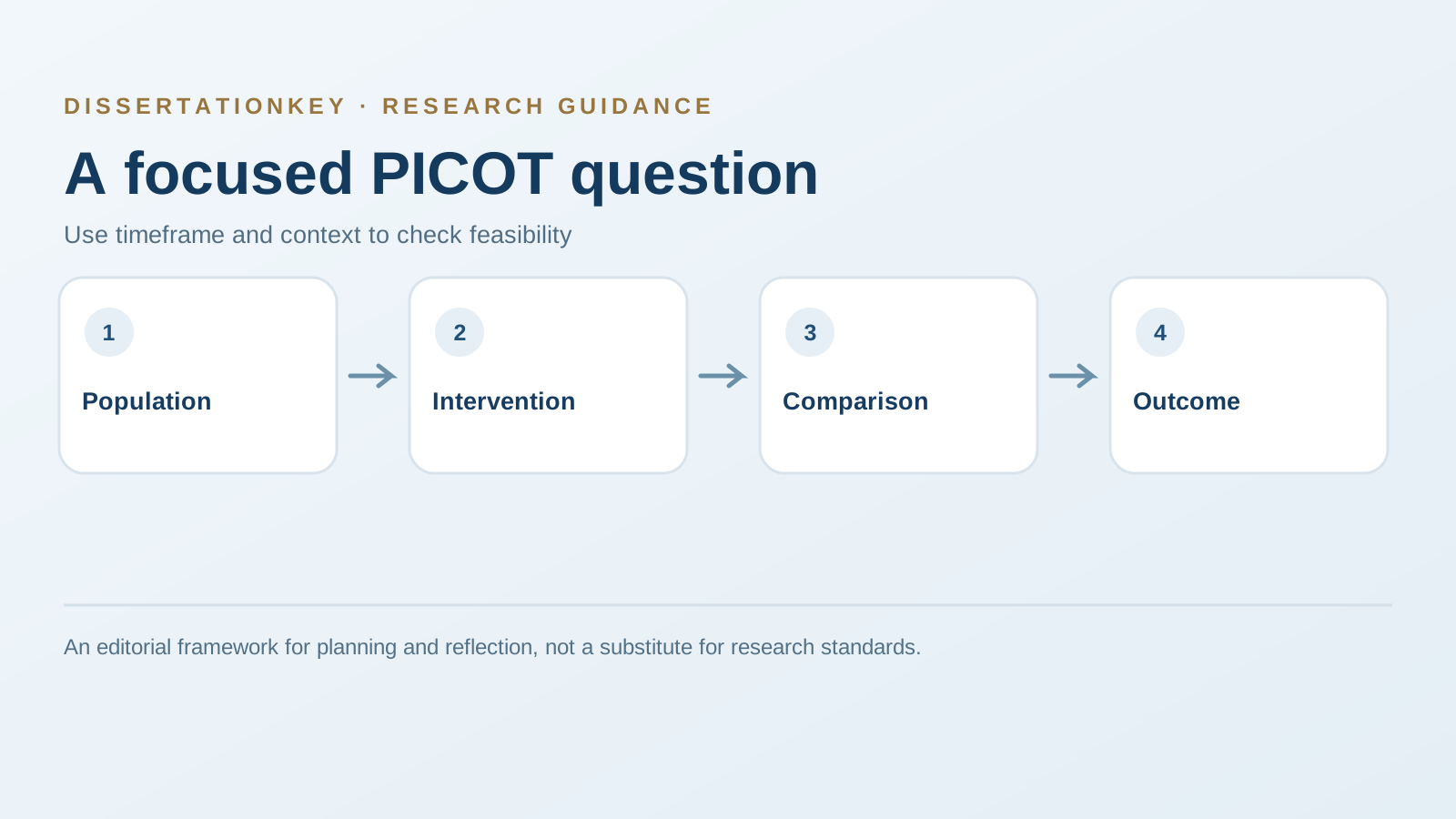
The population identifies the group whose experience or outcomes matter, which may include adults recovering from surgery, older people living with diabetes or nurses working in intensive care. The intervention describes what is being introduced or examined, while the comparison clarifies what the intervention is being assessed against. The outcome should describe a meaningful change that can be observed or measured and the timeframe helps define when that change will be evaluated.
A comparison is not always a placebo or a complete absence of care. In nursing studies it may be usual practice, an existing educational programme or a different method of delivering support. When students leave the comparison unclear, they often discover that their question is difficult to translate into eligibility criteria for a literature search. The timeframe should also be clinically sensible because an outcome measured after a week may tell a different story from the same outcome measured after three months.
Consider a second example involving adults with type 2 diabetes who receive follow up support after leaving hospital. The population could be adults recently discharged following diabetes related admission, while the intervention might be structured telephone follow up delivered by a nurse. The comparison could be routine discharge information without scheduled calls. A relevant outcome might be attendance at follow up appointments or a clearly defined measure of self management over a specified period. Each element changes the evidence that the researcher will need to find. If the intervention is described simply as education, it may encompass classroom teaching, written leaflets, digital reminders and individual counselling. The student should define the intervention at a level that reflects both the clinical question and the way published studies report it. A well specified question makes the later inclusion and exclusion criteria easier to defend.
Work through a nursing example
Consider the question of preventing pressure injuries among adults receiving inpatient care. A draft question might ask whether scheduled repositioning reduces pressure injuries, but this leaves the population, comparison and timeframe uncertain. A more focused version would examine adults admitted to a particular type of inpatient unit, a specified repositioning approach compared with usual prevention practices and new pressure injury incidence during the admission.
The example does not assume that one approach is superior or that the published evidence is uniform. It simply identifies the decisions a researcher would need to make before searching. The student should also consider whether the intervention can be defined consistently across studies, since repositioning schedules and associated prevention measures may differ between hospitals. These differences will matter when interpreting findings.
It is helpful to distinguish the research question from the proposed answer. Students sometimes frame their question as though an intervention has already been proven effective, which can influence the papers they choose to read. A neutral formulation asks whether an approach changes an outcome rather than promising that it will. For the pressure injury example, the student would also need to account for the fact that repositioning is rarely the only prevention measure used in practice. Support surfaces, skin assessment, nutritional care and mobility all influence the broader clinical picture. A review that ignores those factors may compare studies that are too different to interpret together. The purpose of the PICOT framework is not to eliminate clinical complexity, but to make that complexity visible early enough to plan a sensible investigation.
Check whether the question is too broad or too narrow
A question that includes every age group, every hospital setting and every form of education is likely to retrieve studies that cannot reasonably be compared. A question that specifies a highly unusual combination of conditions may retrieve almost nothing, even if the clinical concern is important. Good question development therefore includes a preliminary search to test whether the scope is manageable.
Start with a few relevant search terms in PubMed or another database available through your university. Look for the language authors use to describe the population and intervention, then revise your wording without changing the underlying clinical problem merely to fit a preferred result. A preliminary search is a feasibility check rather than a substitute for the documented search required in a formal systematic review.
A practical scope check involves looking at a small sample of relevant studies and recording how each one defines its population, intervention and outcome. If the papers include long term care residents, intensive care patients and people recovering from elective surgery, the student should decide whether those groups genuinely belong in one question. The answer depends on the clinical purpose rather than a fixed rule about how narrow a topic must be. At the other extreme, a question may be so specific that only one small study appears to match it. That does not make the question invalid, but it changes what can reasonably be concluded. It may be appropriate to broaden the population or remove a nonessential restriction, provided the revised question still addresses the original concern. These early decisions should be documented because they explain why the final question differs from the first draft.
Turn the question into a search strategy
The words in a PICOT question are not automatically the best database search terms. Researchers usually identify synonyms, subject headings and alternative spellings for the main concepts before combining them with Boolean operators. The intervention and population often provide a useful starting point, while an outcome term may sometimes make the search too restrictive if it is described inconsistently across studies.
For example, studies of nurse led discharge education might use phrases such as discharge counselling, patient teaching or transitional care. Testing those alternatives can reveal relevant papers that a literal search for the original PICOT wording would miss. The search strategy should be adapted to each database because subject headings and syntax are not identical across PubMed, CINAHL and other platforms.
Database searching works best when the student keeps the concepts separate before combining them. For a discharge education question, one group of terms might describe the population while another captures nurse led education and related forms of support. Within each group, synonyms are commonly connected with OR, while the main concepts are connected with AND. Quotation marks, truncation and database specific subject headings may help refine a search, although the exact syntax must be checked in each platform. The student should inspect a few relevant articles to see whether the search retrieves them. If an important paper is missing, that may reveal a missing synonym or an overly restrictive condition. Recording the search date, database and search string is good practice even in a preliminary search because it makes the process easier to reproduce and discuss with a supervisor. For a formal evidence synthesis, the search requires a more systematic and documented approach.
Recognise when PICOT is not the right framework
PICOT is particularly useful for focused intervention questions, but nursing research also explores experiences, implementation challenges and the meanings patients attach to care. A qualitative study asking how family caregivers experience home based palliative care may not benefit from forcing an artificial intervention and comparison into the question. Frameworks such as PICo or SPIDER may provide a better structure for those inquiries.
A scoping review can also require a different approach because its purpose may be to map what evidence exists rather than determine whether a specific intervention works. JBI guidance discusses the population, concept and context framework for scoping reviews. Selecting a framework is a methodological decision that should follow the purpose of the project rather than a rule that every nursing student must use PICOT.
A question about how patients experience living with a new stoma illustrates why an intervention framework may feel unnatural. The purpose is to understand experience and meaning, not to compare one treatment with another. A qualitative framework can make room for the population, phenomenon of interest and context without inventing an outcome measure that does not fit the research aim. Similarly, a project mapping how hospitals use digital discharge tools may be better approached as a scoping review than as a narrowly framed effectiveness review. The research framework should be chosen after the question's purpose is clear. This decision also affects which studies are eligible, which databases are useful and how findings can be brought together. Students can save considerable time by resolving that methodological fit before writing a lengthy proposal.
Revise the question with your supervisor
Before treating the question as final, check whether its population is clearly defined, whether the intervention and comparison can be recognised in the literature and whether the outcome is meaningful. A supervisor can help identify ethical, practical or methodological problems that are not obvious from the wording alone. It is also worth checking whether the proposed timeframe is realistic for the assignment or clinical project.
Use the PICOT Question Builder to organise an early draft and keep a record of how the question changes. If your assignment develops into a review, our systematic review guide explains how the question informs eligibility criteria, database searching and synthesis. The strongest question is not necessarily the most complicated one, but the one that makes the next research decisions clearer.
When discussing a draft with a supervisor, bring more than the final sentence. A brief explanation of the clinical problem, the proposed population and a small sample of relevant literature gives the supervisor something concrete to evaluate. It is also useful to describe what has been excluded and why. For instance, a student may decide to focus on adult inpatients because paediatric fall prevention programmes involve different risk factors and interventions. That is a reasoned boundary rather than an arbitrary omission. After feedback, revise the question and check that the planned outcome still matches the intervention. If the wording changes substantially, repeat the preliminary search to ensure the revised question remains feasible. Treating question development as an iterative process is more realistic than expecting a perfect PICOT statement on the first attempt.
Putting the guidance into practice
One final check is to ask whether the proposed outcome can actually be recognised in the studies the student expects to review. Patient satisfaction, for instance, may be measured through different questionnaires and at different stages of care, which makes apparently similar findings harder to compare. Read the methods sections of a few relevant papers before committing to a particular outcome measure. It may be necessary to define a broader outcome category or explain why only certain measures are suitable. The same applies to the timeframe because follow up periods vary considerably across nursing interventions. A clearly written PICOT question cannot resolve every methodological difference, but it can help the student anticipate those differences and explain them honestly when reviewing the evidence. That is particularly important when the assignment requires critical appraisal rather than a simple account of published results.
Research resources and further reading
Check original methodological and reporting resources relevant to PICOT question development. Compare their recommendations with your university’s specific assessment requirements.
- JBI; Methodology and research resources for further reading.
- Cochrane; Methodology and research resources for further reading.
- PubMed; Methodology and research resources for further reading.
- EQUATOR Network; Methodology and research resources for further reading.
- PRISMA; Methodology and research resources for further reading.
Need guidance with your nursing project?
If your clinical question still feels too broad, we can explore the population, intervention, outcomes and practical scope together.
Editorial note. The examples in this guide are illustrative and are not claims about actual patient outcomes. This content is educational and does not replace institutional guidance or clinical advice.