
Writing a Nursing Literature Review That Goes Beyond Summary
Learn how to organise, evaluate and synthesise nursing research into a coherent literature review.
Learn how to organise, evaluate and synthesise nursing research into a coherent literature review. The sections below explain the decisions behind the process and use hypothetical nursing examples where practical, while recognising that individual universities and clinical settings may have different requirements.
Understand what your literature review must accomplish
A nursing literature review should explain what existing research tells us about a problem and how that evidence relates to the question being investigated. Students sometimes approach the chapter as a sequence of paper summaries, but a list of studies rarely shows whether findings agree, where methods differ or which gaps remain. A useful review develops a reasoned account of the evidence that prepares the reader for the study or project that follows.
The expected scope depends on whether the review forms part of a dissertation, a research proposal or a standalone assignment. A dissertation chapter often needs to establish the background and rationale for a new investigation, whereas an evidence synthesis assignment may require more explicit procedures for searching and selecting studies. Your programme handbook should determine the formal requirements, even when the underlying principles of critical reading and synthesis are similar.
Before searching, write a short statement explaining what the review needs to establish for the wider dissertation or assignment. A review supporting a study of medication adherence may need to examine the size of the problem, existing nursing interventions and limitations in how adherence has been measured. Without that purpose, students can collect dozens of interesting articles that do not move the argument forward. The review should have a clear relationship to the research question, but it should not simply repeat the introduction in greater detail. It should explain what the existing literature contributes, where interpretations differ and what remains uncertain. A useful planning technique is to identify three or four questions the reader should be able to answer after finishing the chapter. Those questions can later become the basis of a thematic structure.
Move from a topic to a focused review question
Broad subjects such as patient safety or mental health nursing contain too many different populations and interventions to review meaningfully in a single chapter. Narrowing the focus to a particular clinical issue, setting or patient group gives the literature review a clearer purpose. The question should be precise enough to guide reading without becoming so restrictive that relevant background evidence disappears.
A student interested in medication adherence might focus on nurse led education for adults with long term conditions rather than attempting to cover every adherence intervention. This is a hypothetical illustration, not a claim about the effectiveness of the intervention. The next step would be to examine how published researchers define education, adherence and the patient population, since inconsistent definitions can explain why studies reach different conclusions.
Searching for literature is not the same as searching the internet for convenient quotations. Academic databases offer subject headings, filters and records that can make a search more systematic, although no single database covers every relevant study. Nursing topics often benefit from a combination of biomedical and nursing focused sources. The precise selection depends on institutional access and the research question. Record the databases used, the main search concepts and the dates on which searches were performed. A preliminary search can help refine terminology, especially when different authors use different language for the same intervention or patient experience. Students should also examine the reference lists of important studies and reviews to identify material that a simple keyword search may have missed. The aim is a defensible body of evidence rather than the largest possible collection of papers.
Search beyond the first page of results
A credible literature review needs a deliberate search process rather than a collection of whichever papers appear first in a search engine. Depending on the topic and university access, nursing students may search PubMed, CINAHL, the Cochrane Library and other relevant databases. Search terms should reflect the main concepts and include appropriate synonyms, with the strategy recorded clearly enough that it can be explained in the assignment.
Database searches may need to be supplemented by examining reference lists and checking whether influential studies have been cited by more recent work. At the same time, relevance and quality matter more than simply accumulating a large number of references. Keep a record of why a study was selected and what it contributes to the argument, particularly when it appears to contradict findings from other papers.
A literature matrix becomes useful when it records more than the title and publication year. For each study, note the setting, participants, research design, intervention or phenomenon, relevant findings and limitations. It is particularly helpful to record why the study matters to the specific review question. Two studies may both concern discharge education but differ substantially in patient population, follow up period and outcome measurement. Those differences should be visible before the writing begins. The matrix also helps students notice when they are relying too heavily on one study design or geographic setting. A well organised matrix does not write the synthesis automatically, but it reduces the temptation to describe each article separately in the order it was read. It gives the researcher a practical foundation for comparing evidence across studies.
Read critically rather than collecting quotations
Critical reading asks whether a study's design, sample, setting and measures are suitable for the question it claims to answer. A cross sectional survey can describe associations at a particular point in time, but it generally cannot establish that one factor caused another. A qualitative interview study may provide valuable insight into patient experiences while answering a different kind of question from an intervention trial.
Look closely at how participants were recruited, how missing data were handled and whether the conclusions remain proportionate to the evidence. The purpose is not to dismiss every study that has limitations, since all research involves trade offs. Instead, explain how those limitations affect what readers can reasonably infer and whether the findings apply to the nursing population or setting you are discussing.
Critical appraisal asks whether a study's methods support the conclusions being drawn from it. A randomised trial may offer useful evidence about an intervention, but its findings still depend on recruitment, allocation, follow up and the reliability of outcome measurement. A qualitative interview study requires a different set of questions about sampling, reflexivity, analysis and the relationship between interpretations and participant accounts. The appropriate appraisal framework therefore depends on the design. Students should avoid labelling a study weak merely because its sample is small without considering what the study was trying to achieve. They should also resist describing every published conclusion as established fact. An article may report an association rather than demonstrate causation. Careful appraisal allows the literature review to explain the strength and limits of evidence without becoming dismissive or overly technical.
Build themes that reflect the evidence
Once the papers have been read, group them around meaningful patterns rather than around author names. A review of discharge planning might develop sections on patient understanding, continuity between hospital and community care and barriers to following discharge instructions. Within each section, compare what different studies found and consider whether differences in setting or measurement help explain disagreement.
A thematic structure also helps prevent the chapter from repeating the same background information. Instead of introducing every paper with the phrase that a particular author found something, the writer can make a clear point and then use several studies to examine it. The Literature Review Matrix can help record methods, findings and limitations before deciding how the themes fit together.
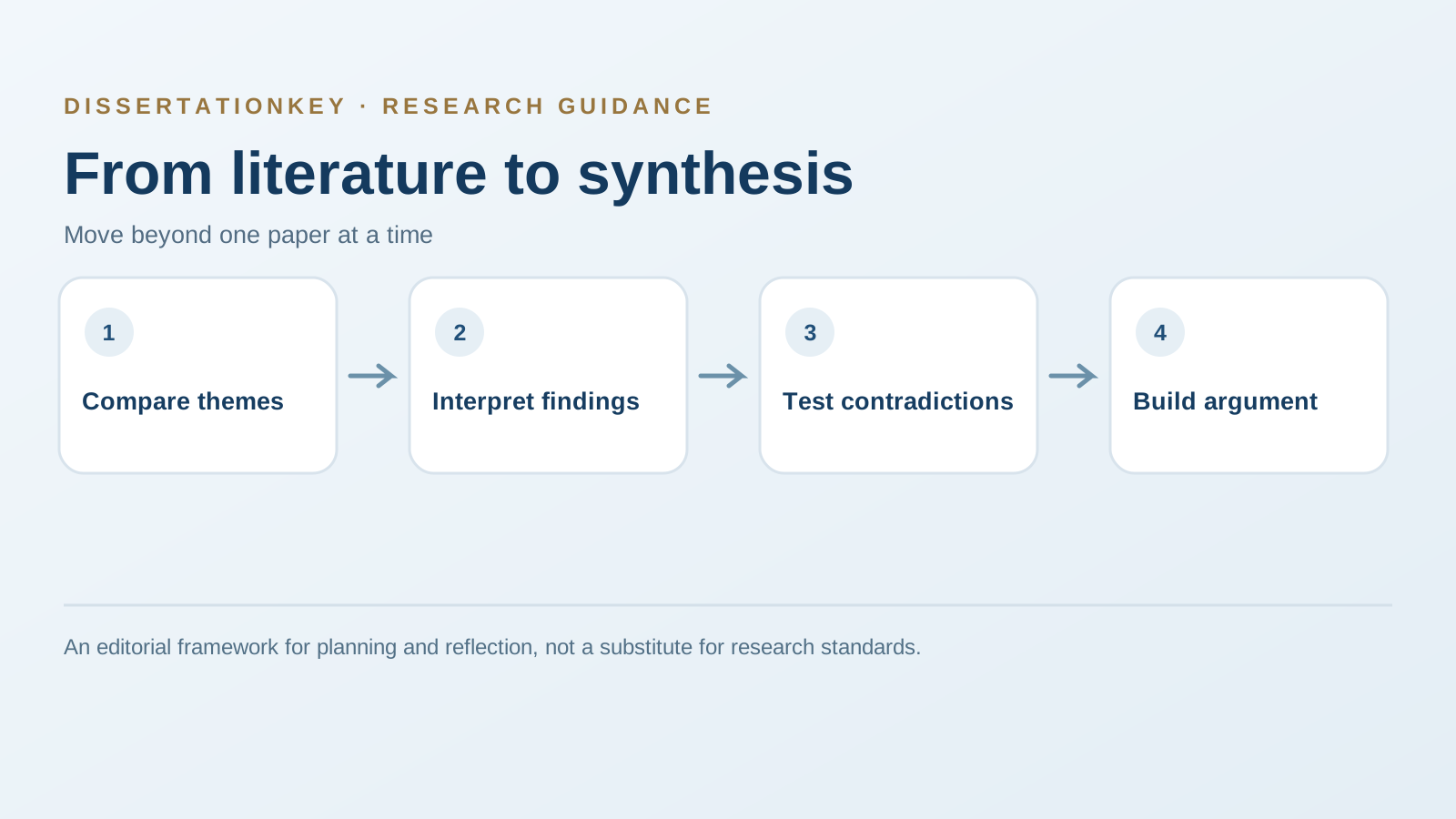
Thematic synthesis involves organising studies around ideas that matter to the research question. In a review of nurse led discharge interventions, themes might include the content of patient education, continuity of follow up and barriers to implementing support. Within each theme, compare what studies found and consider why the findings might differ. An intervention delivered by a specialist nurse in a well resourced clinic may not translate directly to a busy ward with limited staffing. Differences in participant characteristics, intervention intensity and follow up can also explain variation. The paragraph should make an argument about the evidence rather than introduce one paper after another. When findings conflict, describe the disagreement openly and examine plausible methodological reasons. That kind of synthesis is more valuable than a list of study summaries followed by a broad statement that more research is needed.
Write paragraphs that develop an argument
A strong paragraph begins with a meaningful claim about the evidence and follows it with explanation, comparison and appropriate references. It should not merely state that research is important and then move to an unrelated study. The reader needs to understand why the studies are being discussed together and what their combined findings suggest about the review question.
For example, a paragraph might explain that several studies associate structured discharge education with improved patient knowledge while noting that they measured knowledge differently and followed patients for different lengths of time. The paragraph could then discuss why those differences limit direct comparison. This is more informative than reporting one result after another without examining what the findings mean.
A research gap is not simply a topic with few papers. It may involve inconsistent definitions, limited evidence in a particular care setting, inadequate follow up or uncertainty about whether an intervention works for a specific population. A strong gap statement grows out of the evidence discussed in the review. For example, if several studies examine discharge education immediately after hospitalisation but few report outcomes beyond one month, the limitation concerns longer term evidence rather than the complete absence of research. The student should explain why that limitation matters for nursing practice and how the proposed study could contribute. Claims that no research exists should be made cautiously because they require a sufficiently thorough search. More precise language is usually more credible and gives the reader a clearer understanding of the contribution being proposed.
Finish with a defensible research gap
A research gap is not simply the absence of a paper using the exact wording of your proposed title. It may involve limited evidence in a particular setting, inconsistent findings, inadequate follow up or populations that have been underrepresented. The gap should emerge from the studies you have evaluated rather than being announced as a convenient justification for the project.
A conclusion should therefore return to the original question and distinguish what is reasonably established from what remains uncertain. If you are planning a dissertation, the gap should connect directly to the proposed design and methods. Our Methodology Selector can help structure an early discussion about possible approaches, although it cannot replace methodological advice from a supervisor.
Editing should focus first on the logic of the chapter rather than individual word choices. Read the opening and closing sentences of each section to check whether the argument develops in a sensible order. Remove paragraphs that describe studies without explaining their relevance and combine passages that repeat the same point. Check that claims about effectiveness, prevalence or clinical recommendations are supported by the cited evidence. Referencing software can reduce formatting errors, but it does not confirm that a source supports the sentence attached to it. Students should return to the original article whenever a claim is important or potentially controversial. Finally, read the review aloud to identify abrupt transitions and repetitive phrasing. A well written literature review should guide the reader through a line of reasoning rather than feel like a collection of disconnected notes.
Putting the guidance into practice
A practical way to test the quality of a draft is to ask what each paragraph contributes to the argument. Some paragraphs establish the clinical importance of a problem, while others compare study findings or explain why an apparent disagreement may have arisen. If a paragraph does none of these things, it may belong elsewhere or need to be rewritten. Pay attention to the balance between description and interpretation because a literature review cannot become analytical simply by adding phrases such as the evidence suggests. The interpretation must be grounded in the study methods, populations and findings that have been discussed. It is also useful to distinguish the implications for clinical practice from implications for future research. An uncertain finding may justify further investigation without supporting an immediate change to patient care and the writing should make that distinction clear.
Students should also check whether their discussion reflects the date and scope of the evidence search. A paper published recently is not automatically more reliable than an older study, although newer evidence may reflect changes in clinical practice or reporting standards. Explain why influential earlier work remains relevant and whether subsequent research has confirmed or challenged it. When the literature is thin, acknowledge that limitation rather than filling the gap with loosely related sources. This helps the reader understand the confidence that can reasonably be placed in the review's conclusions.
Research resources and further reading
Check original methodological and reporting resources relevant to critical nursing literature synthesis. Compare their recommendations with your university’s specific assessment requirements.
- JBI; Methodology and research resources for further reading.
- Cochrane; Methodology and research resources for further reading.
- PubMed; Methodology and research resources for further reading.
- EQUATOR Network; Methodology and research resources for further reading.
- PRISMA; Methodology and research resources for further reading.
Need guidance with your nursing project?
If the literature feels like an endless collection of articles, we can help you identify the themes, disagreements and gaps that matter to your question.
Editorial note. The examples in this guide are illustrative and are not claims about actual patient outcomes. This content is educational and does not replace institutional guidance or clinical advice.